The black hole of Mill Run

Growing up, I used to pedal my bicycle up to the big bear plus at mill run. Back in those days, Big Bear Plus of Mill Run was a happening place
And the heart of the Mill Run shopping center. CINEMARK movies 12 was right behind the shopping center and after seeing a movie, we would hang outFront or go hang out back at the shopping center.

I remember buying comics up there like captain America or Green Lantern and would ride home feeding some ducks on the way back home. All of this happened before my freshman year of high school when the Big Bear Plus closed its doors.

People began to talk about how someone was embezzling from
The Big bear corporate headquarters causing the entire chain of supermarkets to close down. No more comic books…no more bike rides to the store… No more silly commercials featuring then OSU coach John Cooper. The doors just up and closed. I heard rumors that a Giant Eagle was supposed to move in from neighbors “in the know” about such things but it never developed. The store front remained vacant and empty throughout my high school years, into my undergrad years I’m high school.

After being gone for about 8 years,
My family and I moved back and still that store remains vacant and empty. Sadly, it’s been almost 20 years to the day that that store closed and while a Starbucks has opened up next to it,
Along with Aussie Fit, Chipotle and many other places….STILL it
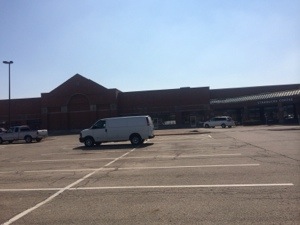
Remains vacant, like some giant black hole in the Mill Run shopping center.

I drove past it today wondering how decrepit the inside of the building has become, why no one has looked at the property in over 20 years but more importantly why no one has figures out a way to transform the space from an empty eye sore into something else (I.e.-movies 12 became the movie tavern, Columbus sports and goods became an ITT center of Hilliard, etc.) some in other major cities have begun to transform old industrial centers into year round community gardens or centers.

I keep thinking “why doesn’t someone do something like this with this place?” Instead, the shopping center remains just that: the black hole of Mill Run.

Hopefully someone can figure out something to do with it before it collapses in on itself.

20140409-141937.jpg

The Anthropology of Beer: East Coast Edition

I recently had the pleasure of taking my family to the State of Delaware for a family vacation and had the further pleasure of spending it with in-laws. We got to go to the beach, which for my children who have never seen the ocean, was a real pleasure (the looks on their faces as we passed over the Chesapeake Bay Bridge was priceless and something I will look back on fondly). I collected sea shells with my daughter, chased waves and got buried in sand with my son and got to walk a small length of Bethany Beach with my wife.
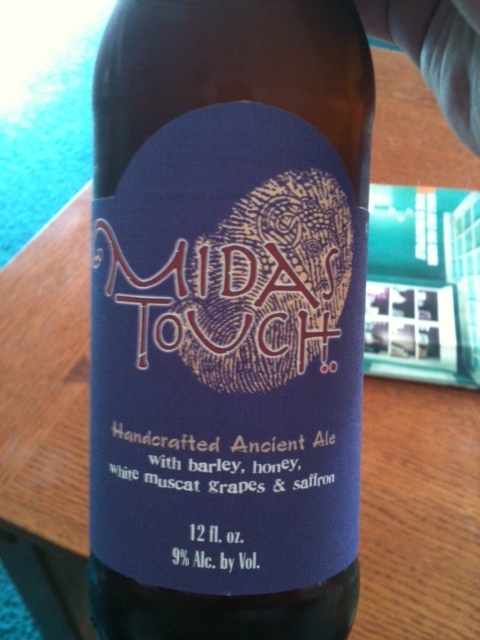
Our first night was spent in Rehoboth Beach as we got to eat at the famed “Dogfish Head Brewery”. It’s one of my father and brother-in-laws favorite breweries. I read about Dogfish Head in an article that appeared in Smithsonian Magazine called “Beer Archaeologist”. The beer I was interested in is called “Midas Touch” and was reproduced from samples that were excavated in Turkey that may have come from the tomb of the actual King Midas (I was secretly hoping that Dr. Patrick McGovern would be there so I could talk with him at length about it his work but, alas, it was not meant to be). I sampled some beers from my father in laws “beer flight” and tried the Midas Touch, an Indian Pale Ale (IPA) and what was labeled as a pomegranate beer but had a vicious after bite (note: a beer flight is a collection of beers in 4 oz. glasses that act as “tasters” and usually are organized from lighter beers to heavier beers).
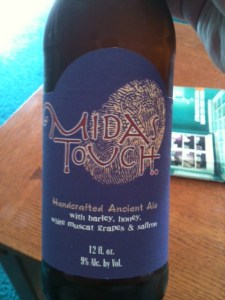
Midas Touch

While two of the places that I got try beer were in Maryland, let’s face it: the only thing that separates the two of these states is a man-made boundary. The people and customs are pretty much the same and the beer is pretty much the same. However, the setting is what separates how the beer is presented and sold to the general public.
At Rehoboth Beach, Delaware, Dogfish Head brewery caters to the tourist nightlife eclectic, putting up a “come as you are” Bohemian welcome to any and all tourists whether their on spring break, family vacation or some surfer dude looking for a good beer.
Travel across the border to Maryland and the same micro-brew style that is presented suddenly becomes just as haughty to be paired with food to make it more delectable.
Travel right down the road to a baseball stadium and a pilsner with a ripped-off image from an opposing team suddenly becomes the drink of drinks of a certain baseball team and its sports fans.
While I’m not saying that National Bohemian beer would pair up well with certain kinds of food (it may pair up well with fish and chips), I find it fascinating that Beer changes with setting here in the US of A, but not with the people as it does in other places of the world. What are your thoughts? What do you think?

The Midas Touch was a lighter beer, somewhere between a white wine and a pilsner. It made me wonder what the exact ingredients were and just how much beer King Midas was buried with for his journey into the afterlife. At the same time, it got me wondering about the ethical questions surrounding topics such as the ownership of beer from archaeological sites, who profits from the sales…but that’s a blog for a different time.
The feeling of the Dogfish Head brewery was somewhat Bohemian and laid back and (at least for this night) kid friendly. The beers were as eclectic and varied as the people who walked the streets toward Rehoboth Beach.

As our vacation went on, I got to travel to Baltimore with my wife, brother-in-law and sister in law. We got to see the Indians win against the Orioles at Camden Yards (which is an awesome stadium) and drink some local beers beforehand. We stopped at a restaurant on the harbor called the Rusted Spiggot and I tried a couple of local micro-brews with my brother in law. The restaurant, despite the name, was upscale and the beers paired very well with the fresh seafood.

The Midas Touch was a lighter beer, somewhere between a white wine and a pilsner. It made me wonder what the exact ingredients were and just how much beer King Midas was buried with for his journey into the afterlife. At the same time, it got me wondering about the ethical questions surrounding topics such as the ownership of beer from archaeological sites, who profits from the sales…but that’s a blog for a different time.
The feeling of the Dogfish Head brewery was somewhat Bohemian and laid back and (at least for this night) kid friendly. The beers were as eclectic and varied as the people who walked the streets toward Rehoboth Beach.

Full Tilt Brewery

As our vacation went on, I got to travel to Baltimore with my wife, brother-in-law and sister in law. We got to see the Indians win against the Orioles at Camden Yards (which is an awesome stadium) and drink some local beers beforehand. We stopped at a restaurant on the harbor called the Rusted Spiggot and I tried a couple of local micro-brews with my brother in law. The restaurant, despite the name, was upscale and the beers paired very well with the fresh seafood.

We then drove back to our hotel which was directly across the street from Camden Yards. Next door to our hotel was a local pub called “the Pickled Pub” which was advertising about, quote “cheap a** beer!!” While not sounding appealing in the slightest, we wanted to enjoy the pre-game festivities with the locals. My brother-in-law talked with a gaggle of locals once we were carded and approved by security for the bar. We asked what local beer we should try to which they all enthusiastically agreed that we should try the “National Bohemian Beer”.
Bohemian

The can for the beer- needing one of those key chain looking can openers to pop the lid- was orange and featured what looked like a rip-off of the Cincinnati Reds baseball headed mascot only with a white circle for a head and a Cyclops eye, dressing up like an Oriole baseball player from an age long ago. The beer tasted like Natural Light, only heavier and packed a punch that snuck up on you at the end. It was kind of like the Baltimore Orioles fans that heckled us Indians fans that night: Light Hearted heckling and jesting in fun, but stingy in their words.
“The Emptied Prairie” revisited: a review of National Geographic’s article, 5 years later

When I moved to Bismarck, North Dakota back in 2007, it seemed that the entire state of North Dakota was in a tizzy about an article that had been published by National Geographic called “The Emptied Prairie”.

Not knowing what the big hub-bub was all about, I picked up a copy that featured the article and read it. Complete with images of decaying cattle bones in front of abandoned homesteads, creepy baby doll heads and images of abandoned school houses that would make Ms. Havasham feel right at home, the article talks about how smaller towns in North Dakota were “emptying out” with the older populations keeping the towns alive, but the younger generations moving to bigger cities. One extreme case refers to the small town of Epping, North Dakota where a child had been the first born in the town for almost 20 years.
When I read the article at first, I thought to myself “I don’t really know what the big deal is” and shelved my copy.

Fast forward five years and I now find myself back in my hometown and as I look back on my time in North Dakota, the article seemed to have been published at the wrong time. Sure, many of the small towns are in critical decline and still are. But with the oil boom and with the number one economy in the nation, many of these so called “emptying prairies” are starting to grow once again.

One such town that was described in the article was Marmath, which sits in the heart of the oil patch. While the town is still in critical decline, the author of the article failed to mention that Marmath is somewhat of a writer’s village with writer’s from around the world coming to visit the town to work on their art. Marmath also happens to be the heart of many a paleontological expedition in recent years, with some incredible discoveries coming out of the badlands that surround the small town. Another town mentioned in the article, Amidon, was described in such a way that it seemed that the town was in imminent danger of dying. The truth is that Amidon has been the nation’s smallest county seat LONG before National Geographic stopped by to talk of the town’s impending doom. The town also has a sense of humor with a police car complete with a dummy dressed as an officer located on the edge of town to scare oil workers or tourists to slow down.

With the oil boom has come problems with housing and the refusal (see Williston) to build housing in fear that the oil boom will not last much longer. With this problem, most oil companies have started to get creative with the building of lodges by companies like “Target Logistics”. These “Man Camps” are being built on the periphery or within the oil patch and most towns (Glen Ullin) are starting to prepare for an influx in the population.

While there is so much to talk about further (i.e.-Man Camps) I will be looking at these in later articles. For now, I can say that the “Emptied Prairie” has bounced back, if only momentarily. Who knows? National Geographic may be back writing an article called “BUST” when the oil boom ends with pictures of decrepit man camps littering the horizon.

Ohio Department of Transportation Project near Grant Birthplace reveals large number of artifacts

 As an archaeologist, I get to do some pretty cool things: I get to excavate sites and analyze artifacts that most people haven’t touched or seen in over a century (or more), I get to write about these discoveries and interact with colleagues and the public about this data.

One great pleasure that I get working at the Ohio Historical Society (OHS) is interacting with local historical societies, the general public and with various agencies.  I had the chance to do all three recently at the Grant Birthplace in Point Pleasant, Ohio  for an Ohio Department of Tranportation (ODOT) project.  The project and its results are detailed in the link below:

http://ohio-archaeology.blogspot.com/2013/05/odot-project-near-us-grant-birthplace_21.html

With the discovery of the pipes, saggers and medicine bottle fragment and the historic information that we at OHS were able to recover about the medicine bottle, I have been thinking about doing a paper on some of the pipes and pipe factories that helped influence this Point Pleasant during an interesting time in American history. 

Stay tuned for more discoveries!