The black hole of Mill Run

Growing up, I used to pedal my bicycle up to the big bear plus at mill run. Back in those days, Big Bear Plus of Mill Run was a happening place
And the heart of the Mill Run shopping center. CINEMARK movies 12 was right behind the shopping center and after seeing a movie, we would hang outFront or go hang out back at the shopping center.

I remember buying comics up there like captain America or Green Lantern and would ride home feeding some ducks on the way back home. All of this happened before my freshman year of high school when the Big Bear Plus closed its doors.

People began to talk about how someone was embezzling from
The Big bear corporate headquarters causing the entire chain of supermarkets to close down. No more comic books…no more bike rides to the store… No more silly commercials featuring then OSU coach John Cooper. The doors just up and closed. I heard rumors that a Giant Eagle was supposed to move in from neighbors “in the know” about such things but it never developed. The store front remained vacant and empty throughout my high school years, into my undergrad years I’m high school.

After being gone for about 8 years,
My family and I moved back and still that store remains vacant and empty. Sadly, it’s been almost 20 years to the day that that store closed and while a Starbucks has opened up next to it,
Along with Aussie Fit, Chipotle and many other places….STILL it
Remains vacant, like some giant black hole in the Mill Run shopping center.

I drove past it today wondering how decrepit the inside of the building has become, why no one has looked at the property in over 20 years but more importantly why no one has figures out a way to transform the space from an empty eye sore into something else (I.e.-movies 12 became the movie tavern, Columbus sports and goods became an ITT center of Hilliard, etc.) some in other major cities have begun to transform old industrial centers into year round community gardens or centers.

I keep thinking “why doesn’t someone do something like this with this place?” Instead, the shopping center remains just that: the black hole of Mill Run.

Hopefully someone can figure out something to do with it before it collapses in on itself.

20140409-141937.jpg

Book review: Paul brown- the man who invented modern football

Many football coaches have left there mark in recent years: Bill Walsh and the west coast offense, Dick LeBeau and the 3-4 defense, Chip Kelly and his warp speed spread offense, Urban Meyer and the spread offense. But all of these coaches – including Bill Walsh who wrote the forward of this book – trace their football lineage to a single coach: Paul Brown. In fact, Bill Walsh based his west coast offense on many of the tenants of Paul Browns’ offense. This book traces his early years as a high school football coach who inspired half-starved players during the depression, to his years as the Ohio State University’s head coach and first national championship in 1942, to his meteoric rise as Cleveland’s head coach. Most tragic was how he eventually became a victim of his own success and his old ways of sacrifice, withholding gratification and selflessness eventually came into conflict with what has become too common in modern football.
From his creation of a face mask for football helmets, to using the fullback in the running game to his passing offense to even including marching bands in high school football, this book explores how Paul Brown’s touch on football is still felt to this day. After reading this book, I thought how Paul Brown should be considered the ORIGINAL Mr. Ohio Football.
Four out of five stars.

a LONG hiatus

Hello Dear Readers!!

Its been a LONG time since my last post and not due to lack of trying. 

One of the primary reasons that this has taken me so long to get back to is life in general: My wife and I welcomed a new baby boy to our family back in August and about one month later, I found myself looking for a new job since my contract with the Ohio Historical Society expired.  I just want to thank Sharon Dean, Debbi Huff, Brad Lepper, Bill Pickard and Linda Pansing for giving me the chance to live out my boyhood dream of working for the Ohio Historical Society and for taking a chance on me. 

About a month before my contract expired, I got a job working third shift at a Tim Horton’s shop where I was baking goods for the morning shift from 10 pm-6am.  I ended up getting another job with GFS Chemicals as a Repack associate where I help break down various organic, inorganic and flammable chemicals and acids for laboratory use and ensure QA/QC standards are to spec’s.  I worked here from 7am-330 pm.  I also opened an online eBay store called “City on a Hill Collectibles” where I sell collectibles, antiques and gifts.  So, for a full month my schedule was to wake up, shower, shave, go work from 7-330, eat dinner, spend some time with my kids, sleep, wake up, go to Tim Hortons and work from 10-6 and MAYBE catch a half hour of sleep.  My weekends during this time consisted of playing with my kids (when I was conscious), listing on my eBay store and trying to catch up on sleep.  I did this for about a month before I finally decided that I couldn’t do it anymore and ended up quitting at Tim Horton’s.  I can say without a doubt that I am not afraid of eating anything there after having baked it night after night (except for the steak meals, two words: MEAT LOG >:-(~

Anywho, what will come next?  Well, I have some book reviews in my que and those will be forthcoming.  I’m also going to start a series on surviving unemployment or not even having to go on it.  I’m also looking at trying to write some more on archaeology and some of the sites in Ohio that you may or many not know of.  So please stay tuned and know that only the BEST is yet to come!! 🙂


The Anthropology of Beer: East Coast Edition

I recently had the pleasure of taking my family to the State of Delaware for a family vacation and had the further pleasure of spending it with in-laws. We got to go to the beach, which for my children who have never seen the ocean, was a real pleasure (the looks on their faces as we passed over the Chesapeake Bay Bridge was priceless and something I will look back on fondly). I collected sea shells with my daughter, chased waves and got buried in sand with my son and got to walk a small length of Bethany Beach with my wife.
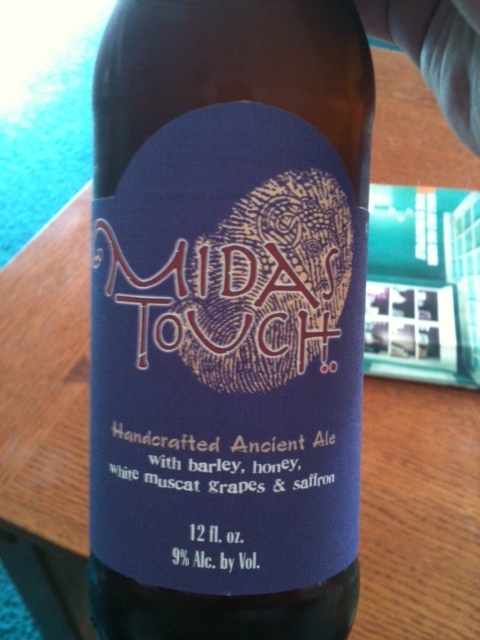
Our first night was spent in Rehoboth Beach as we got to eat at the famed “Dogfish Head Brewery”. It’s one of my father and brother-in-laws favorite breweries. I read about Dogfish Head in an article that appeared in Smithsonian Magazine called “Beer Archaeologist”. The beer I was interested in is called “Midas Touch” and was reproduced from samples that were excavated in Turkey that may have come from the tomb of the actual King Midas (I was secretly hoping that Dr. Patrick McGovern would be there so I could talk with him at length about it his work but, alas, it was not meant to be). I sampled some beers from my father in laws “beer flight” and tried the Midas Touch, an Indian Pale Ale (IPA) and what was labeled as a pomegranate beer but had a vicious after bite (note: a beer flight is a collection of beers in 4 oz. glasses that act as “tasters” and usually are organized from lighter beers to heavier beers).
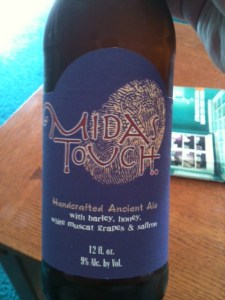
Midas Touch

While two of the places that I got try beer were in Maryland, let’s face it: the only thing that separates the two of these states is a man-made boundary. The people and customs are pretty much the same and the beer is pretty much the same. However, the setting is what separates how the beer is presented and sold to the general public.
At Rehoboth Beach, Delaware, Dogfish Head brewery caters to the tourist nightlife eclectic, putting up a “come as you are” Bohemian welcome to any and all tourists whether their on spring break, family vacation or some surfer dude looking for a good beer.
Travel across the border to Maryland and the same micro-brew style that is presented suddenly becomes just as haughty to be paired with food to make it more delectable.
Travel right down the road to a baseball stadium and a pilsner with a ripped-off image from an opposing team suddenly becomes the drink of drinks of a certain baseball team and its sports fans.
While I’m not saying that National Bohemian beer would pair up well with certain kinds of food (it may pair up well with fish and chips), I find it fascinating that Beer changes with setting here in the US of A, but not with the people as it does in other places of the world. What are your thoughts? What do you think?

The Midas Touch was a lighter beer, somewhere between a white wine and a pilsner. It made me wonder what the exact ingredients were and just how much beer King Midas was buried with for his journey into the afterlife. At the same time, it got me wondering about the ethical questions surrounding topics such as the ownership of beer from archaeological sites, who profits from the sales…but that’s a blog for a different time.
The feeling of the Dogfish Head brewery was somewhat Bohemian and laid back and (at least for this night) kid friendly. The beers were as eclectic and varied as the people who walked the streets toward Rehoboth Beach.

As our vacation went on, I got to travel to Baltimore with my wife, brother-in-law and sister in law. We got to see the Indians win against the Orioles at Camden Yards (which is an awesome stadium) and drink some local beers beforehand. We stopped at a restaurant on the harbor called the Rusted Spiggot and I tried a couple of local micro-brews with my brother in law. The restaurant, despite the name, was upscale and the beers paired very well with the fresh seafood.

The Midas Touch was a lighter beer, somewhere between a white wine and a pilsner. It made me wonder what the exact ingredients were and just how much beer King Midas was buried with for his journey into the afterlife. At the same time, it got me wondering about the ethical questions surrounding topics such as the ownership of beer from archaeological sites, who profits from the sales…but that’s a blog for a different time.
The feeling of the Dogfish Head brewery was somewhat Bohemian and laid back and (at least for this night) kid friendly. The beers were as eclectic and varied as the people who walked the streets toward Rehoboth Beach.

Full Tilt Brewery

As our vacation went on, I got to travel to Baltimore with my wife, brother-in-law and sister in law. We got to see the Indians win against the Orioles at Camden Yards (which is an awesome stadium) and drink some local beers beforehand. We stopped at a restaurant on the harbor called the Rusted Spiggot and I tried a couple of local micro-brews with my brother in law. The restaurant, despite the name, was upscale and the beers paired very well with the fresh seafood.

We then drove back to our hotel which was directly across the street from Camden Yards. Next door to our hotel was a local pub called “the Pickled Pub” which was advertising about, quote “cheap a** beer!!” While not sounding appealing in the slightest, we wanted to enjoy the pre-game festivities with the locals. My brother-in-law talked with a gaggle of locals once we were carded and approved by security for the bar. We asked what local beer we should try to which they all enthusiastically agreed that we should try the “National Bohemian Beer”.
Bohemian

The can for the beer- needing one of those key chain looking can openers to pop the lid- was orange and featured what looked like a rip-off of the Cincinnati Reds baseball headed mascot only with a white circle for a head and a Cyclops eye, dressing up like an Oriole baseball player from an age long ago. The beer tasted like Natural Light, only heavier and packed a punch that snuck up on you at the end. It was kind of like the Baltimore Orioles fans that heckled us Indians fans that night: Light Hearted heckling and jesting in fun, but stingy in their words.

The importance of letters

Recently I read an article about a 65-year old woman who bought a bible at a used bookstore only to find an essay that she had written herself at the age of 10 and 2,000 miles away in Lexington, KY. It got me wondering about the importance of the written word and how what we write today can affect us years later. In history and archaeology, these are especially important tools as they reveal the thoughts and ideas of an individual during the era in which they lived. In today’s technologically driven world, we have text messages, emails and social media blitzing us at every moment and I think we as a culture have forgotten the importance of writing a simple letter.

Which brings me to a story about the importance of letters. This story involves my big brother, Adam Herson. When we were young, my brother was a avid sports fan. He could tell you the statistics of any athlete and even call plays during live football games before they even happened. I was awe struck at his athletic brilliance and wondered how he knew so much about sports and the nueansence of offenses and defenses. 

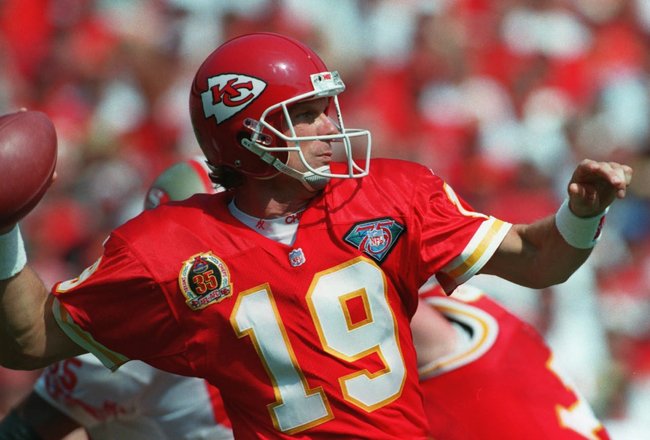
In 1989, my brother wrote a letter to Joe Montana wishing him luck in Superbowl XXIV.  While the San Fransisco 49ers would crush the Denver Broncos in that game 55-10, Joe would not reply to my brothers letter.  But this wasn’t because Joe was stuck up or didn’t have the time: the letter was never sent


joe-montana-kansas-city-chiefs

On April 18, 1995, Joe Montana would announce his retirement before a crowded stadium in San Fransisco.  Despite playing for the Kansas City Chiefs at this point, Joe went out in style.  I remember this day vividly because when I got home from school, I picked up the mail and noticed a manilla envelope from the Kansas City Chiefs addressed to my brother.  I didn’t really think anything of it at first, but when my brother got home, I told him that he had some mail.  He took the manilla envelope and went around a corner and opened it.  There was a deafening silence that followed that was broken only by an “Oh my God”. I rounded the corner and asked my brother what was in the envelope.  He showed me: It was an autographed picture of Joe Montana in his Kansas City Chiefs uniform. 

It turned out that my dad had saved the letter and found it in a bedroom drawer.  He mailed it to the Kansas City Chiefs for Joe Montana to read.  The timing was impecable and I wonder what Joe thought when he read a 6-year old letter from an avid fan right before his retirment.  My brother would frame the photo and keep it on his desk for years to come. 

I think back to that moment and how simple a written letter on a piece of paper can go.  I’m hoping that it doesn’t eventually become a totally lost art for future generations as the written word can hold so much power, especially for years to come.

“The Emptied Prairie” revisited: a review of National Geographic’s article, 5 years later

When I moved to Bismarck, North Dakota back in 2007, it seemed that the entire state of North Dakota was in a tizzy about an article that had been published by National Geographic called “The Emptied Prairie”.

Not knowing what the big hub-bub was all about, I picked up a copy that featured the article and read it. Complete with images of decaying cattle bones in front of abandoned homesteads, creepy baby doll heads and images of abandoned school houses that would make Ms. Havasham feel right at home, the article talks about how smaller towns in North Dakota were “emptying out” with the older populations keeping the towns alive, but the younger generations moving to bigger cities. One extreme case refers to the small town of Epping, North Dakota where a child had been the first born in the town for almost 20 years.
When I read the article at first, I thought to myself “I don’t really know what the big deal is” and shelved my copy.

Fast forward five years and I now find myself back in my hometown and as I look back on my time in North Dakota, the article seemed to have been published at the wrong time. Sure, many of the small towns are in critical decline and still are. But with the oil boom and with the number one economy in the nation, many of these so called “emptying prairies” are starting to grow once again.

One such town that was described in the article was Marmath, which sits in the heart of the oil patch. While the town is still in critical decline, the author of the article failed to mention that Marmath is somewhat of a writer’s village with writer’s from around the world coming to visit the town to work on their art. Marmath also happens to be the heart of many a paleontological expedition in recent years, with some incredible discoveries coming out of the badlands that surround the small town. Another town mentioned in the article, Amidon, was described in such a way that it seemed that the town was in imminent danger of dying. The truth is that Amidon has been the nation’s smallest county seat LONG before National Geographic stopped by to talk of the town’s impending doom. The town also has a sense of humor with a police car complete with a dummy dressed as an officer located on the edge of town to scare oil workers or tourists to slow down.

With the oil boom has come problems with housing and the refusal (see Williston) to build housing in fear that the oil boom will not last much longer. With this problem, most oil companies have started to get creative with the building of lodges by companies like “Target Logistics”. These “Man Camps” are being built on the periphery or within the oil patch and most towns (Glen Ullin) are starting to prepare for an influx in the population.

While there is so much to talk about further (i.e.-Man Camps) I will be looking at these in later articles. For now, I can say that the “Emptied Prairie” has bounced back, if only momentarily. Who knows? National Geographic may be back writing an article called “BUST” when the oil boom ends with pictures of decrepit man camps littering the horizon.

The Underground book review: “The Haunted Wrestling Mansion:A Fight between Darkness and Light” by M.E. Erickson

haunted wrestling mansion

When I lived in North Dakota, my wife and I heard about a little bookstore across the river in Mandan, North Dakota called “Huntington Books”. The bookstore is known as the “oldest bookstore in Mandan” and is a mash up between “Half-priced books” and the kind of underground record store you would find in Chicago. It was here that I found a copy of the “Haunted Wrestling Mansion” by local author M.E. Erickson. The premise behind the book is what caught my attention and I decided to give it a try.

The book is about a mansion in the small town of Lincoln that housed a sort of low-level WWE (think ECW or TNA, just not as violent…sort of…more on that later..) that was the rave of Bismarck/Mandan. The whole populations of Bismarck and Mandan (according to the numbers described in the book) would empty out and crowd this mansion to partake of the festivities…that is until a horrible accident on live TV closes the doors of the mansion and the eventual end of the WWE-esque pro-wrestling federation (see what I meant about violence and wrestling?). Fast-forward to the present, where the book’s protagonist is describing the events that lead up to his ending up in a hospital bed and recounting to the police what had happened after the Mansion reopens under a new wrestling federation with an unscrupulous new owner.

The book harkens to a battle between good and evil such as that in Frank Perreti’s “This Present Darkness” and has the wrestling background of “No Holds Barred“. The writing style is incredibly rough, with the writing style appearing at time to be written in a hurried manner without being fully edited (or published as is). The book is more of a guilty pleasure, along the lines of a low-rated B-movie horror type, but is a wonderful gem if you can dig it.

Look for this book and you won’t be disappointed..you may even get a laugh or two out of it 🙂

3 out of 5 stars

“The Real All-Americans” by Sally Jenkins: a book review

“The Real All-Americans” is a gem for history and sports buffs in that it combines both almost effortlessly, and is written in such a way that you don’t need to understand football terminology (i.e.-what is a “wish-bone” formation?) or be familiar with the often dark period of time in american history known as the “Indian Wars”.

The book tells the story of the founding of the Carlisle school and an imaginative- if not unscrupulous- football coach, “Pop” Warner.  While the book advertises that that the story ultimately is about the 1903 game between Carlisle and West Point Academy, the book is more about the football players of Carlisle and how their inventiveness and fortitude would ultimately change early american football from a “run first” mentality, to the game of forward passing that it is known as today.  While many of their early “trick plays” would be deemed illegal today (i.e.-one play called “the hunchback”), the tenacity and fortitude of men such as David Exendine and the future olympian Jim Thorpe, would forever change the game of football. 

What is interesting about this book is how it speaks about  issues that still haunt football today, namely that of violence in the game.  Early American college football was so violent that in one season, seven people lost their lives.  The book also examines the issue of players being given “preferential treatment” over other students and other issues in College Football that still have yet to be resolved today.

Sally Jenkins does an amazing job of putting together an extensive background on not only the descendants of the men and women of Carlisle, but also paints a picture of Carlisle’s founder, Richard Henry Pratt, as a complicated and oft-misunderstood charachter and an individual who often was full of contraditctions. 

In short, “the Real All-American’s” is a book that speaks volumes about the birth and nature of American Football as well as the men who helped to create the game that many know and love today.  I HIGHLY recommend this book to any and all who are interested in American history, football or Native American Biographies. 

5 out of 5 stars.